

Department profile
The Department of Electronics and Communications Engineering (ECE) was established in the year 2010 along with the Institution to produce skilled and socially responsible Electronics and Communication Engineers. Currently, our department is offering undergraduate program (B.Tech) in Electronics & Communications Engineering with an intake capacity of 30. Electronics and Communication, one of the widely renowned branches in the field of Engineering, have proved time and again, that they play a pivotal role in both the developing and well-being of our society in the fast-paced human life. ECE department has a team of well qualified, experienced and committed staff members with excellent team spirit. The department laboratories have the state of art equipment and high-quality lab practices with experienced supporting staff which encourages students to pursue self-developed and innovative project works. ECE branch is concerned with the design, development, manufacture and application of electronic devices, circuits and systems. The department library offers reference books and technical magazines for quick references. The department periodically organizes seminars and workshops to train faculty and students on emerging research areas and trends in the area of Electronics Engineering. The department tries to ensure intellectual, ethical and social development amongst the students. We always try to inculcate the much-needed leadership qualities along with the integral technical education such that our students can be job creators rather than job seekers.
WHY STC ECE
Electronics and Communication Engineering is considered the backbone of the modern communication system. In the current scenario, modern applications like the Internet of Things (IoT), Robotics, and Embedded Systems are highly dependent on the knowledge of ECE. One of the prime objectives of our ECE program is to equip students with the necessary core competency in order to succeed in life after completing the same. The program focuses on the design of underlying hardware systems. The curriculum is managed for applications in major areas including IT industry, defence, telecommunications, electronics and hardware manufacturing, embedded systems development, software development etc.
- Vision
To produce skilled and socially responsible Electronics and Communication Engineers.
- Mission
M1: Provide facilities and experiential learning for developing skilled engineer.
M2: Create a framework for Industry Academic Interactions to enrich Professional Practices.
M3: Encourage ethical and interpersonal skills to address the societal and industrial needs.
- Vision
To produce skilled and socially responsible Electronics and Communication Engineers.
- Mission
M1: Provide facilities and experiential learning for developing skilled engineer.
M2: Create a framework for Industry Academic Interactions to enrich Professional Practices.
M3: Encourage ethical and interpersonal skills to address the societal and industrial needs.

Dr. Asish B Mathews
Professor & Head
asish@stthomascollege.ac.in
Message from the HoD
The Department of Electronics and Communication Engineering was started in 2010. We strive to cultivate a dynamic learning environment where students are empowered to become future leaders in the field of technology. With a focus on innovation, research, and industry collaboration, we are committed to providing our students with a comprehensive education that prepares them for the challenges and opportunities of the modern world.
Our faculty members are renowned experts in their respective fields, dedicated to delivering high-quality instruction and mentoring students in their academic and professional endeavors. Through hands-on projects, industry internships, and research opportunities, our students gain practical experience and develop the skills necessary to excel in their careers.
As technology continues to evolve at a rapid pace, the demand for skilled professionals in the ECE domain is always higher
PSO1:Professional Skills:
Analyse, design, implement and test analog and digital electronic circuits, microprocessor systems, signal processing, communication networking, VLSI and embedded system applications.
PSO2: Design and development skills:
Ability to design and develop the electronic circuits, communication and software systems to fulfil industry and social needs.
Analyse, design, implement and test analog and digital electronic circuits, microprocessor systems, signal processing, communication networking, VLSI and embedded system applications.
PSO2: Design and development skills:
Ability to design and develop the electronic circuits, communication and software systems to fulfil industry and social needs.
Engineering knowledge :
Apply the knowledge of mathematics, science, engineering fundamentals, and an engineering specialization to the solution of complex engineering problems.
Problem analysis :
Identify, formulate, review research literature, and analyse complex engineering problems reaching substantiated conclusions using first principles of mathematics, natural sciences, and engineering sciences.
Design/development of solutions :
Design solutions for complex engineering problems and design system components or processes that meet the specified needs with appropriate consideration for the public health and safety, and the cultural, societal, and environmental considerations.
Conduct investigations of complex problems:
Use research-based knowledge and research methods including design of experiments, analysis and interpretation of data, and synthesis of the information to provide valid conclusions.
Modern tool usage :
Create, select, and apply appropriate techniques, resources, and modern engineering and IT tools including prediction and modelling to complex engineering activities with an understanding of the limitations.
The engineer and society :
Apply reasoning informed by the contextual knowledge to assess societal, health, safety, legal and cultural issues and the consequent responsibilities relevant to the professional engineering practice.
Environment and sustainability :
Understand the impact of the professional engineering solutions in societal and environmental contexts, and demonstrate the knowledge of, and need for sustainable development.
Ethics :
Apply ethical principles and commit to professional ethics and responsibilities and norms of the engineering practice.
Individual and team work :
Function effectively as an individual, and as a member or leader in diverse teams, and in multidisciplinary settings.
Communication :
Communicate effectively on complex engineering activities with the engineering community and with society at large, such as, being able to comprehend and write effective reports and design documentation, make effective presentations, and give and receive clear instructions.
Project management and finance :
Demonstrate knowledge and understanding of the engineering and management principles and apply these to one’s own work, as a member and leader in a team, to manage projects and in multidisciplinary environments.
Life-long learning :
Recognize the need for, and have the preparation and ability to engage in independent and life-long learning in the broadest context of technological change.
Apply the knowledge of mathematics, science, engineering fundamentals, and an engineering specialization to the solution of complex engineering problems.
Problem analysis :
Identify, formulate, review research literature, and analyse complex engineering problems reaching substantiated conclusions using first principles of mathematics, natural sciences, and engineering sciences.
Design/development of solutions :
Design solutions for complex engineering problems and design system components or processes that meet the specified needs with appropriate consideration for the public health and safety, and the cultural, societal, and environmental considerations.
Conduct investigations of complex problems:
Use research-based knowledge and research methods including design of experiments, analysis and interpretation of data, and synthesis of the information to provide valid conclusions.
Modern tool usage :
Create, select, and apply appropriate techniques, resources, and modern engineering and IT tools including prediction and modelling to complex engineering activities with an understanding of the limitations.
The engineer and society :
Apply reasoning informed by the contextual knowledge to assess societal, health, safety, legal and cultural issues and the consequent responsibilities relevant to the professional engineering practice.
Environment and sustainability :
Understand the impact of the professional engineering solutions in societal and environmental contexts, and demonstrate the knowledge of, and need for sustainable development.
Ethics :
Apply ethical principles and commit to professional ethics and responsibilities and norms of the engineering practice.
Individual and team work :
Function effectively as an individual, and as a member or leader in diverse teams, and in multidisciplinary settings.
Communication :
Communicate effectively on complex engineering activities with the engineering community and with society at large, such as, being able to comprehend and write effective reports and design documentation, make effective presentations, and give and receive clear instructions.
Project management and finance :
Demonstrate knowledge and understanding of the engineering and management principles and apply these to one’s own work, as a member and leader in a team, to manage projects and in multidisciplinary environments.
Life-long learning :
Recognize the need for, and have the preparation and ability to engage in independent and life-long learning in the broadest context of technological change.
PEO1 : Portray Engineering Practices
Implement Best Practices in the Project or Assigned Task by applying Engineering Knowledge.
PEO2 : Leadership Ability
Exhibit leadership skills, team work, interpersonal and communication skills in the organization and society.
PEO2 : Lifelong Learning
Exhibit life-long learning skills through constant knowledge up-gradation and Soft Skills.
Implement Best Practices in the Project or Assigned Task by applying Engineering Knowledge.
PEO2 : Leadership Ability
Exhibit leadership skills, team work, interpersonal and communication skills in the organization and society.
PEO2 : Lifelong Learning
Exhibit life-long learning skills through constant knowledge up-gradation and Soft Skills.
News & Events
-
 Congratulations to the Toppers of ECE(2022-26 Batch)
 -
 Congratulations to the Toppers of ECE(2021-25 Batch)
 -
 Congratulations to the Toppers of ECE(2021-25 Batch)
 -
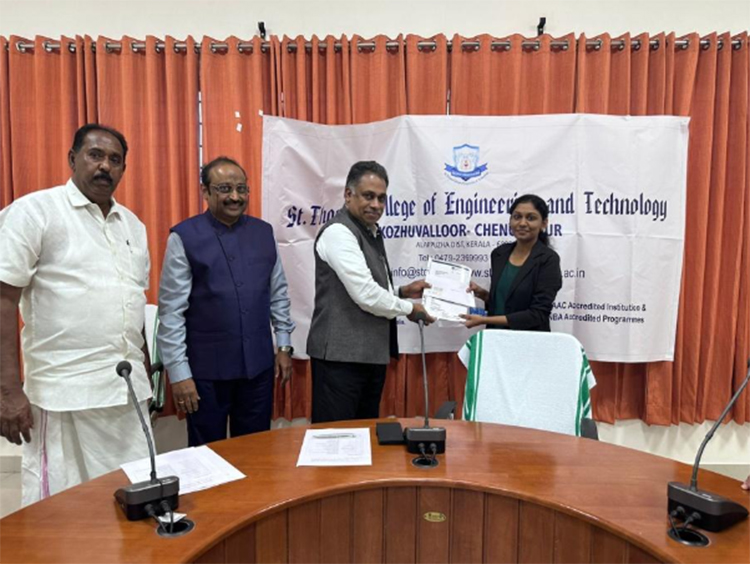 Jyothy Lakshmi, Bestin Jacob and Sudhi P S of S8 ECE (2020-2024 Batch)
 -
 Nandhu A G, Jyothy Lakshmi and Krishnapriya M of S8 ECE (2020-2024 Batch)